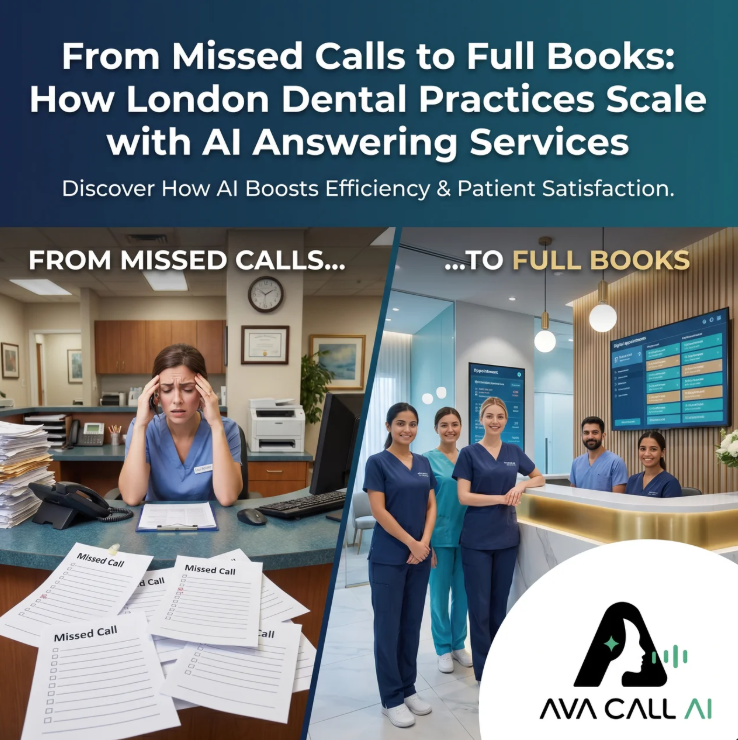
London private dental practices have a quiet revenue problem. It's not treatment quality. It's not patient retention. It's the phone ringing during the lunch rush with no one to answer it, the Friday 5 PM cosmetic inquiry hitting voicemail, the Saturday morning Invisalign lead who called three practices before yours and booked with the second one.
AI answering services built specifically for dental workflows solve this. Not by replacing your front desk — but by making sure every call that lands in the gap between "staff are busy" and "practice is closed" actually goes somewhere useful.
Notes
- London private dental practices lose an estimated £3,000–£8,000 per missed new patient call when lifetime treatment value is factored in.
- AI answering services answer 100% of calls 24/7, triage emergency vs. routine intent, book directly into the practice diary, and fire an automated SMS follow-up to missed callers within 90 seconds.
- The critical variable is not the AI voice quality — it's whether the system integrates with your Practice Management Software (Dentally, SOE/EXact) and respects your clinical scheduling logic.
- UK GDPR and CQC compliance are non-negotiable. Any AI system processing patient call audio requires a Data Processing Agreement and lawful basis under UK GDPR Article 6.
- The right implementation treats AI as a permanent safety net, not a full replacement. Practices that get the most out of it route complex clinical conversations to staff while automating everything else.
The Real Cost of a Missed Call at a London Dental Practice
A missed call is not a missed phone call. It's a missed patient relationship.
For a private London practice focused on cosmetic and restorative work, a new patient inquiry is typically worth £1,500–£5,000 in first-year treatment, and multiples of that over a patient lifetime. An Invisalign case alone runs £3,000–£5,500. A full implant treatment, £2,500–£5,000 per arch.
When that call hits voicemail at 1:15 PM on a Tuesday — the classic lunchtime surge when two staff are checking in physical patients and one is processing payments — the patient doesn't leave a message. They call the next practice. In London, there's always a next practice.
The practices that have installed call tracking retrospectively often discover they've been leaking 15–25 calls per week during peak hours. At a conservative £2,000 average treatment value and a 20% conversion rate, that's £6,000–£10,000 per week in recoverable revenue.
AI answering services close this gap permanently.
How AI Answering Services Actually Work for Dental Practices
An AI answering service for a dental practice is not a voicemail with a robot voice. It's a real-time conversational AI that handles inbound calls, identifies call intent, executes against the practice's scheduling logic, and routes clinical complexity to a human when needed.
The workflow looks like this at a well-configured London practice:
Step 1 — Call received. The AI answers within 2 rings, 24 hours a day. It introduces itself using the practice's preferred name and voice persona.
Step 2 — Intent classification. The AI identifies whether the call is a new patient inquiry, appointment booking, rescheduling, billing question, emergency, or general enquiry. This happens conversationally, not through a numeric menu system.
Step 3 — Booking or routing. For routine bookings, the AI reads the live practice diary, identifies available slots that match the treatment type and practitioner, and confirms the appointment with the patient. For emergencies — severe pain, trauma, suspected swelling — it follows a clinical safety protocol: gathering the urgency level, providing NHS 111 or A&E guidance if appropriate, and transferring to an on-call contact or capturing a priority callback.
Step 4 — Confirmation and follow-up. Booked patients receive an SMS confirmation immediately after the call. Missed callers who hung up before speaking receive an automated "we missed your call" text within 90 seconds with a booking link.
Step 5 — Data capture. All call data, patient details, and booking actions sync to the CRM. The practice manager gets a call summary digest at the start of each business day.
The part that's often underestimated: step 3 is only as good as the integration. If the AI cannot read and write directly into the practice's diary in real time, it becomes a sophisticated message-taking service rather than a true scheduling agent.
The Integration Question: SOE, Dentally, and PMS Sync
The most common concern practice managers raise after the initial demo is this: does the AI actually book into our system, or does it just send an email to the front desk?
This is the right question to ask.
A properly configured AI answering service integrates with the Practice Management Software via API, allowing it to read live diary availability and write confirmed appointments directly into the system. For the two dominant PMS platforms in London's private dental market — Software of Excellence (SOE/EXact) and Dentally — this is technically achievable, but the implementation quality varies significantly between providers.
What you're checking for specifically:
Real-time diary read. The AI should be querying live slot availability at the moment of the call, not working from a cached export.
Booking logic enforcement. The system needs to respect practitioner-specific rules: buffer times between appointments for surgery clean-down, treatment-type to practitioner matching, new patient assessment slots versus follow-up slots.
Clean-down intervals. CQC clinical standards require specific decontamination time between patients. An AI that ignores these buffers creates both a compliance risk and a staffing crisis when appointments stack incorrectly.
No duplicate entry. If the AI creates a record that staff then have to manually reconcile or delete, the time saved on the call is lost to administrative cleanup — and staff will resent the system quickly.
Ask any AI provider for a live demonstration of a test booking that writes directly into a SOE or Dentally demo environment before signing anything.
Handling the Scenarios That Actually Cause Anxiety
Three specific scenarios tend to be where practice managers get stuck when evaluating AI answering systems.
The Emergency Call at 2 AM
A patient calls at 2:12 AM with severe dental pain. The AI needs to do several things correctly here: identify the urgency level (severe pain signals clinical escalation), not attempt to book a routine appointment for an acute problem, provide appropriate signposting to NHS 111, and capture the patient's details for a first-thing-in-the-morning priority callback.
A system without a clinical triage protocol will either fail this call (try to book a hygiene appointment) or pass it entirely, leaving the patient without help. A well-configured system handles it cleanly — the patient feels heard, gets appropriate guidance, and the practice retains the relationship.
The Patient Who Changes Subject Mid-Call
This is the scenario that separates functional AI from genuinely good AI. A patient calls to reschedule a checkup appointment. Halfway through, they mention they've been having sensitivity on the upper left side and want to know if that needs to be seen sooner.
The AI needs to handle this intent shift without resetting the conversation. It should recognise the new clinical signal, prioritise accordingly, offer an urgent or advisory slot, and complete both the original reschedule and the new concern in one call.
Systems built on rigid linear call scripts break here. Conversational AI models that maintain context across the full call duration handle it.
UK Accent Variation and London Name Phonetics
London is one of the most phonetically diverse cities in the world. A patient may have a South Asian name, an Eastern European surname, a Caribbean accent, and a postcode in SE14. The AI needs to handle all of this without repeated confirmation failures that erode the caller's patience.
This is a legitimate technical concern. The better AI voice systems in 2026 — particularly those built on modern speech recognition models — handle accent variation well. But it's worth testing with a range of accents and name types during a pilot before full deployment.
UK GDPR and CQC Compliance: What Practices Must Have in Place
Any AI system processing patient call audio at a UK dental practice is handling special category data under UK GDPR (health information). This creates specific obligations.
Data Processing Agreement (DPA). The AI provider is acting as a data processor on behalf of the practice (the data controller). A written DPA is legally required under UK GDPR Article 28. If a provider cannot produce this, do not proceed.
Lawful basis. Processing patient call data requires a lawful basis under Article 6. For dental practices, legitimate interests or contractual necessity typically apply for booking and administrative calls.
Data residency. Patient audio and transcript data should be processed and stored within the UK or EEA. Confirm this with the provider explicitly.
ICO registration. The practice must be registered with the ICO as a data controller. AI-assisted call processing should be reflected in your Record of Processing Activities (ROPA).
Disclosure. Patients should be informed they may be speaking with an automated system. This can be handled in the AI's opening line: "You're speaking with Ava, our AI receptionist. I can help you book, reschedule, or direct your call." This satisfies both GDPR transparency requirements and practical patient expectations.
CQC. The Care Quality Commission's Regulation 17 (Good Governance) requires that records are accurate and fit for purpose. If AI-generated booking data introduces errors that staff must manually correct, this creates a compliance and audit trail issue.
The Staff Buy-In Problem (and How to Solve It)
The implementation failure mode that no software provider talks about openly is this: the front desk team actively works against the system.
This happens when staff perceive the AI as a replacement threat or when the system creates extra work (cleaning up booking errors, re-entering data, fielding patient complaints about the AI).
The practices that implement this well introduce it differently. The framing that works is not "the AI will answer calls" — it's "the AI handles calls while you're with a patient, so you never have to choose between the person in front of you and the person on the phone."
Practically: run a four-week pilot during peak hours only (lunchtime and after hours). Let staff see that the AI does not touch calls they're available to take. Show them the weekly call summary — particularly the calls that came in on Saturday that would have gone to voicemail and instead got booked. The data converts sceptics faster than any argument.
The second thing that helps: give staff visibility into the AI's call log in real time. When they can see exactly what the AI said, what it booked, and what it passed to them, the black-box anxiety disappears.
What a Well-Configured AI Answering Service Costs (vs. Hiring)
For context: a full-time London dental receptionist costs £28,000–£35,000 per year in salary, plus National Insurance, pension contributions, holiday cover, and sick pay. The real all-in cost is closer to £40,000–£45,000.
A properly configured AI answering service for a London private practice runs £400–£1,500 per month depending on call volume, integration depth, and whether it covers voice only or extends to web chat and WhatsApp follow-up. That's £4,800–£18,000 per year.
The comparison is not "AI replaces receptionist." The correct framing is "AI covers the hours, volume peaks, and after-hours windows that a single receptionist cannot cover — at a fraction of the cost of a second hire."
The growth tier that makes the most sense for most London practices is one that includes inbound AI voice, outbound missed call SMS sequences, web chat automation, and WhatsApp follow-up. This covers the full communication surface of the practice and eliminates the lead leakage problem comprehensively.
Frequently Asked Questions
Does an AI answering service actually book directly into Dentally or SOE?
A properly integrated AI answering service can read and write directly into dental Practice Management Software including Dentally and Software of Excellence (SOE/EXact), provided the provider has built the relevant API integration. This allows the AI to check real-time diary availability, enforce booking rules (buffer times, practitioner-treatment matching), and confirm appointments without creating a separate entry for staff to reconcile. Always verify this with a live demonstration using a test environment before purchasing.
Is it legal under UK GDPR to have an AI record and process patient calls?
Yes, with the correct legal framework in place. The AI provider must sign a Data Processing Agreement as your data processor under UK GDPR Article 28. The practice needs a documented lawful basis for processing (typically legitimate interests or contractual necessity for booking-related calls). Patient audio data should be stored within the UK or EEA. Patients should be informed they are speaking with an AI system at the start of the call to satisfy transparency requirements.
What happens if a patient calls with a dental emergency at 2 AM?
A well-configured AI answering service includes a clinical triage protocol for emergency calls. The AI identifies urgency signals (severe pain, trauma, swelling), provides appropriate signposting to NHS 111 or emergency services for acute clinical situations, and captures the patient's details for a priority callback when the practice opens. It does not attempt to book routine appointments for emergency presentations. The specific triage logic should be configured with input from the practice principal.
Will my front desk staff resist an AI phone system?
Resistance typically comes from two sources: job security anxiety and bad system experiences (cleanup work, patient complaints). Both are manageable. Position the AI as covering calls during periods staff are unavailable — not replacing calls staff would otherwise take. Run a pilot during peak hours first so staff can see the AI's behaviour before it handles general volume. Give the team access to the AI's call log in real time so there are no black-box concerns. Practices that frame it as "the AI protects your attention when you're with a patient" consistently report fast staff adoption.
How does the AI handle UK regional accents and complex London names?
Modern AI voice systems in 2026 handle phonetic diversity significantly better than systems from two or three years ago. That said, performance varies between providers. Before deploying, test with a range of accents representative of your patient base, including South Asian, Eastern European, Caribbean, and West African phonetic patterns. Test postcode input specifically — London postcodes with alphanumeric combinations like "SE14 6NP" are a known failure point in older speech recognition systems. Request a pilot period rather than committing to a long contract before accent performance is verified.
What is the difference between an AI answering service and a traditional dental answering service?
A traditional dental answering service uses human agents (often off-site, often outsourced) to take messages and relay them to the practice by email or voicemail. The patient experience is slow, the message handoff creates errors, and out-of-hours coverage is expensive. An AI answering service handles calls in real time, integrates directly with the practice diary, books appointments without human relay, fires SMS confirmations immediately, and operates at the same quality level at 3 AM on a bank holiday as at 10 AM on a Tuesday.
Does the AI handle situations where the caller changes their reason for calling mid-conversation?
This depends on the system architecture. AI systems built on rigid script trees fail when callers change intent mid-call. Conversational AI models that maintain context across the full call duration handle this correctly. Before selecting a provider, test this explicitly: call the demo number, start with one intent, then introduce a second concern partway through. A system that resets or gets confused is not suitable for dental reception work, where mid-call intent changes are routine.
What to Do With This Information
The practices that move on this in the next six months will own the benchmark in their local area before it becomes table stakes. AI answering is not a feature any more — it's infrastructure, the same way online booking was infrastructure in 2012.
Start with a call audit. Most practice management software can pull missed call data retrospectively. Count the calls that went unanswered in the last 30 days, apply your average new patient treatment value, and multiply by your conversion rate. That number is your baseline cost of doing nothing.
If the number is significant, run a 30-day AI answering pilot covering lunchtime (12:00–14:00) and after hours only. Measure booked appointments from those windows. The data makes the next decision easy.
Figures based on modelled scenarios using industry averages. Practice-specific results will vary.