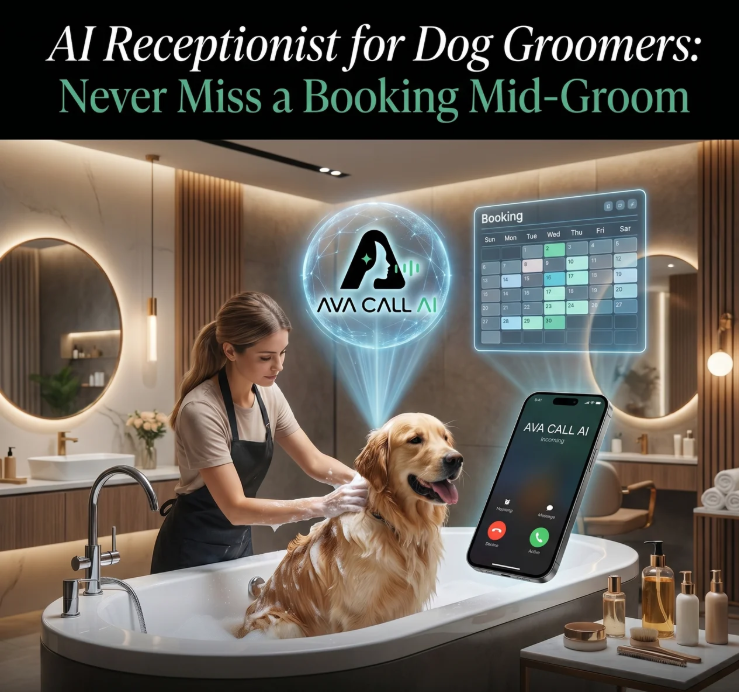
is Ava the best Ai Receptionist for Dog Groomers?
- An AI receptionist for dog groomers answers every inbound call 24/7, even when your hands are wet, the high-velocity dryer is on, or you're mid-groom and can't put the dog down.
- It doesn't just take a message. It asks the breed, coat condition, last groom date and whether there are mats, then books the right time slot into your existing calendar and takes a deposit.
- This matters because 80%+ of callers who hit voicemail leave no message, and 85% never call back — they ring the next groomer on Google.
- UK groomers are mostly solo or home-based (around 10,600 groomers, only ~2,500 with a shopfront), so there's no front desk to catch the call. The AI is the front desk.
- Ava from Ava Call AI does this for UK grooming salons from £397/mo, with a 48-hour go-live and a 10-booking guarantee.
Why dog groomers miss more calls than almost any other business
Groomers miss calls because of physics, not laziness. You can't answer a phone with wet hands holding a nervous dog on a slip lead, scissors in the other hand, with a high-velocity dryer drowning out every word. So the call goes to voicemail, the caller hangs up, and the booking goes to whoever picks up next.
This is the part generic "answering service" pages never say out loud. They talk about "lead capture" and "24/7 availability" like a groomer is sitting at a desk waiting to be efficient. The reality is louder and messier. On the busy grooming subreddits, the same line comes up again and again: the salon is so loud that to hear a customer at all, someone has to physically walk into the hallway and shut the door behind them. You cannot do that with a half-dried doodle on the table.
So most calls aren't "ignored." They're impossible to take in the moment. And the cost lands later, off the clock, when you're staying late to return fifteen voicemails and playing phone tag with people who've already booked elsewhere. The UK grooming industry is worth roughly £420 million and growing about 5% a year, with around 12 million dogs needing regular grooming. Demand isn't the problem. Catching it while your hands are full is.
What an AI receptionist for dog groomers actually does
An AI receptionist is a voice agent that answers your salon's phone in a natural human-sounding conversation, qualifies the caller, and books or reschedules the appointment directly in your calendar without you touching the phone. For a groomer specifically, it's trained to ask the questions that actually decide the price and the time block.
Here's the difference that matters. A standard human answering service takes a message: "Hi, a lady called about her dog, here's her number." You still have to ring back, qualify, and quote. A grooming-aware AI receptionist runs the actual booking conversation:
- "What breed is she, and roughly what weight?"
- "When was her last groom?"
- "Is the coat matted at all, or pretty well maintained?"
- "Is this a full groom, a bath and tidy, or a puppy's first visit?"
From those answers it slots the right length of appointment into your diary, flags a possible de-matting fee, takes a deposit to lock the slot, and texts the owner a confirmation. You find out about the booking when you next glance at your phone, not when you have to stop working to earn it.
Ava, the AI receptionist from Ava Call AI, always identifies herself as AI on the call. She doesn't pretend to be a person, she doesn't give veterinary advice, and she sticks to booking, quoting ranges, and answering common questions. The point isn't to fool the caller. It's to make sure the caller gets a fast, useful answer instead of a beep.
The real cost of a missed call in a grooming salon
A missed call in grooming almost never becomes a callback. Industry research from Hiya's State of the Call report consistently finds that 80% or more of callers who reach voicemail hang up without leaving a message, and around 85% of people who don't get through on the first try never ring back. They tap the next groomer in the search results instead. Phone leads also convert far better than web enquiries, by some industry estimates close to ten times the rate of a website form, because the person calling has an active need right now.
Stack that against how UK grooming actually operates. Most groomers are solo. Of roughly 10,600 pet groomers in the UK, only about 2,500 have a high-street location; the rest run from home or a mobile van. There is no receptionist. There is one person, and that person is usually elbow-deep in a wet dog when the phone rings.
Here's a modelled example to make the maths concrete. Say you take 20 booking calls a week and, on a busy day, miss a third of them while grooming. That's roughly 6–7 missed calls a week. If 80% never leave a message and most of those don't call back, you're quietly losing 4–5 genuine enquiries a week. At an average groom of £45 and a client who comes back every 6–8 weeks, even a handful of those becoming regulars is well into four figures of recurring revenue a year, walking out the door on hold music. (Figures are a modelled scenario using industry-average behaviour, not a guarantee; your numbers depend on your call volume and pricing.)
The uncomfortable part: you already paid to make that phone ring. The Google listing, the Instagram, the word-of-mouth — all of it spent to generate a call that then died at a voicemail beep.
AI receptionist vs answering service vs voicemail
The fastest way to choose is to compare what each option actually does the moment a caller can't reach you. Voicemail records and hopes. A human answering service takes a message and bills per call. An AI receptionist completes the booking. For a solo groomer, only one of those protects revenue without protecting it manually later.
| Voicemail | Human answering service | AI receptionist (e.g. Ava) | |
|---|---|---|---|
| Answers every call 24/7 | No | Office hours, often per-call cost | Yes, including nights and weekends |
| Asks breed, coat, last groom, mats | No | Rarely — usually just a message | Yes, every time |
| Books into your calendar | No | Sometimes, extra cost | Yes, directly |
| Takes a deposit | No | No | Yes |
| Prevents double-booking | No | Depends | Yes, real-time |
| Cost model | Free, but leaks revenue | Per call or per minute | Flat monthly |
| You still ring people back | Yes, all of them | Yes, most of them | No |
Voicemail is the worst of the three because it feels free. It isn't. It's the trapdoor that drops the caller you paid to acquire straight onto a competitor's line.
Can an AI really handle grooming-specific questions?
Yes — a grooming-trained AI handles breed, coat condition and pricing variables better than a general answering service, because it's built to ask the questions that set the price. This is the exact thing owners worry about, and it's the gap most articles skip. A generic call centre doesn't know a hand-strip from a doodle cut. A grooming AI does, because those branches are written into how it qualifies and quotes.
Walk through a real scenario. It's 4pm, you're mid-groom on a matted cockapoo, dryer screaming. A new owner rings: muddy labradoodle, never been groomed, slightly anxious on the phone. Ava picks up on the first ring. She asks the breed and rough size, confirms it's a first full groom, asks when the coat was last brushed out, and gently flags that if it's significantly matted there may be a de-matting fee, quoting a range rather than a hard figure. She books a longer first-visit slot so you're not squeezed, takes a deposit to cut no-shows, and texts the owner the time and what to bring. You never broke stride.
That's the citation gap nobody fills: connecting the physical reality of the salon to a booking conversation that's actually competent about coats and breeds. The AI isn't replacing your judgement on the dog. It's handling the front-desk conversation so the right job lands in your diary, correctly priced, while your hands stay on the clippers.
Does it work with my booking system?
In most cases you keep your existing calendar — you don't rip out your software. A good AI receptionist connects to the diary you already use and books into it, with real-time checks so it can't double-book a slot you've just filled. The fear of "do I have to switch my whole system" is the single biggest thing that stalls groomers, and it's usually unfounded.
Ava books into your existing calendar setup and confirms availability live before it offers a time, so two callers can't grab the same Saturday morning slot. If you don't have a proper booking calendar yet, that gets set up as part of go-live. Either way, the goal is one diary that you and the AI both read from, not a second system to babysit.
How to set one up without losing your weekend
Setup should take days, not weeks, and shouldn't pull you off the table for long. The practical path is: forward your salon number to the AI, plug it into your calendar, load your services and price ranges, and set the questions it asks before booking. From there it answers live and you review the bookings it makes.
With Ava Call AI specifically, go-live is 48 hours, there are no setup fees and no per-call charges, it's a flat monthly price you can cancel any time, and there's a 10-booking guarantee. On the compliance side — which matters more than groomers expect once they're taking deposits and holding client details — Ava Call AI is ICO registered, UK GDPR and PECR compliant, and signs a data processing agreement with every client. Pricing for the AI receptionist runs Essential at £397/mo, Growth at £697/mo, and Premium at £1,297/mo, so a solo home-based groomer and a multi-bench high-street salon aren't paying the same.
Frequently Asked Questions
How much does an AI receptionist for dog groomers cost in the UK?
Ava Call AI's receptionist starts at £397/mo (Essential), £697/mo (Growth), and £1,297/mo (Premium). It's a flat monthly fee with no setup costs and no per-call charges, and you can cancel any time. For a solo groomer, the entry tier typically pays for itself if it saves a handful of bookings a month that would otherwise have gone to voicemail.
Will an AI receptionist actually know dog breeds and coat types?
Yes. A grooming-trained AI is set up to ask the breed, rough size, coat condition, last groom date and whether there's matting, and to quote a price range based on those answers. That's the core difference from a generic human answering service, which usually just takes a message and leaves you to ring back and qualify.
Do I have to change my booking software?
No, in most cases you keep your current calendar. The AI connects to it and books into it, with live availability checks to prevent double-booking. If you don't already run a booking calendar, that's set up during go-live.
Can it take deposits and reduce no-shows?
Yes. Ava can take a deposit at the point of booking to lock the slot, which is one of the most effective ways to cut no-shows, especially for longer first-visit and de-matting appointments.
Is an AI receptionist GDPR compliant?
It needs to be, because it handles caller details and payments. Ava Call AI is ICO registered, UK GDPR and PECR compliant, and signs a data processing agreement with every client. Compliance isn't an upsell, it's the baseline.
What happens to calls at night and on weekends?
The AI answers them. That's a large share of the value — owners often ring in the evening or at the weekend when they're home with the dog and finally have a minute. Voicemail loses those almost entirely; the AI books them.
Will my clients know they're talking to an AI?
Yes, and that's by design. Ava always identifies as AI on the call. The aim is a fast, accurate booking, not deception. In practice most owners care far more about getting an instant answer than about whether the voice booking their dog in is human.
Ultimately
If you're a UK groomer, the phone isn't your problem. The fact that you physically can't answer it mid-groom is. Voicemail doesn't solve that; it just delays the loss and hands it to a competitor while you're staying late returning calls. An AI receptionist closes the gap by completing the booking in the moment your hands are full — asking the right grooming questions, quoting a sensible range, taking a deposit, and dropping it in your diary.
The lowest-friction way to see what you're currently losing is a free AI Audit from Ava Call AI: it shows where calls are leaking and what catching them would be worth for a salon your size, with no commitment to anything afterwards.