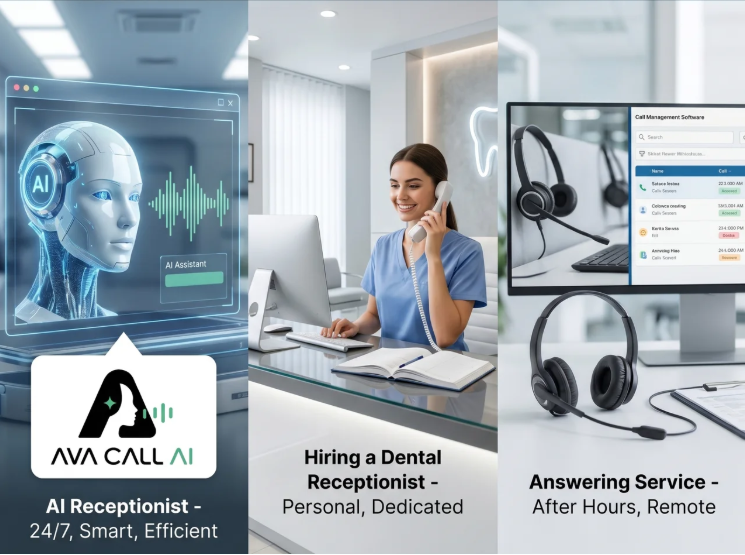
If your dental practice is missing calls — and most do, at peak times and after hours — there are three realistic routes to fixing it. You can hire another receptionist. You can use a human call-answering service. Or you can add an AI receptionist such as Ava.
None of these is wrong. Each fits a different practice type, budget, and tolerance for operational complexity. What follows is an honest look at all three.
Option 1: Hire a second (or additional) receptionist
What it costs
A full-time dental receptionist in the UK earns between £20,000 and £28,000 per year depending on experience and location. Add National Insurance (13.8% above the secondary threshold), mandatory pension contributions, and statutory holiday cover, and the true employment cost sits between £27,000 and £35,000 per year for a single hire.
A part-time receptionist — two or three days per week — reduces the salary line but introduces gaps on the days they are not in. Most practices that try part-time cover still find they miss calls on the uncovered days.
What it solves
A second receptionist handles overflow on busy lines, adds a face-to-face presence that patients appreciate, and manages tasks beyond call handling — patient check-in, NHS paperwork, card payments. If your practice has genuine front-desk volume that requires a physical presence, this is a real solution for that specific problem.
What it does not solve
A second receptionist works one shift. Calls that arrive after 5pm, at weekends, or during their own lunchbreak are still missed. They cannot be in two places simultaneously, so checkout queues still cause the second line to ring out. Sick leave and annual leave create gaps that typically go uncovered, because practices rarely hire redundancy at this level.
They also cost the same whether the phones are busy or quiet, and they escalate every year with salary reviews, National Insurance thresholds, and any changes to statutory entitlements.
The hidden cost of waiting to hire
The average time to recruit, onboard, and have a new receptionist fully productive at a dental practice is six to twelve weeks. During that window, the missed calls — and their revenue implications — continue.
Option 2: Use a human answering service
What it costs
Reputable UK dental call-answering services — including Moneypenny, Posh Answering Service, and practice-specific providers — typically charge between £150 and £600 per month, depending on call volumes and the level of scripting involved. Some charge per minute; others per call handled.
What it solves
A human answering service provides warm, professional call handling by trained operators, including out-of-hours coverage. Callers speak to a person, which some patients — particularly older NHS patients — prefer. Setup is fast: typically two to five working days.
What it does not solve
The core limitation is integration. Human answering services capture a message and pass it on — usually by email or SMS — for your reception team to act on later. They do not book directly into your practice management system (Dentally, SOE Exact, Carestream R4, iSmile). That means every call they handle creates a callback action for your team. You have moved the miss from "unanswered" to "answered but not booked" — which is progress, but it reintroduces the delay that causes enquiries to go cold.
For high-intent callers — particularly Invisalign enquiries, implant enquiries, and cosmetic bookings — that callback delay is often enough for the patient to book elsewhere.
Human answering services also struggle with dental-specific nuance: NHS vs. private triage, NHS charge-band questions, PMS-specific booking logic, and clinical emergency escalation. They follow a generic script. Patients who ask a specific question often get a "I'll pass that on to the practice" response, which is not the same as having the question answered.
The Moneypenny comparison
Moneypenny is the market leader in UK human answering services and a well-run operation. The detailed comparison between Moneypenny and Ava for dental practices is covered in the Moneypenny alternative page. The short version: for practices that need 24/7 cover with live PMS booking, Ava does more for less. For practices that receive very low call volumes and want a human voice above everything else, Moneypenny is a credible choice.
Option 3: An AI receptionist
What it costs
Ava's Essential plan starts at £397 per month (June 2026 pricing), covering up to 500 calls per month with 24/7 answering, calendar booking, SMS confirmations, and call transcripts. The Growth plan at £697 per month adds multi-line routing (up to three lines), WhatsApp automation, CRM integration, and review-request automation. Premium at £1,297 per month adds unlimited lines, web chat, multilingual support, and a dedicated success manager.
Setup takes 48 hours from contract to live. There is no setup fee, no minimum contract term, and cancellation is rolling monthly.
What it solves
Ava answers every inbound call, on every line, simultaneously — including overflow, out-of-hours, weekends, and the second line during checkout. She books directly into your practice management system (Dentally, SOE Exact, Carestream R4, iSmile, Practice-Web) in real time, so there is no callback layer and no rekeying.
She handles dental-specific call logic: NHS vs. private triage, charge-band explanations, new-patient registration, implant finance conversations, anxious-patient reassurance, and GDP referral capture. She identifies herself as an AI receptionist on every call — this is both UK 2026 ASA-compliant and, in practice, well-received by patients who simply want to book without waiting on hold.
She does not call in sick, does not need holiday cover, and does not have a lunchbreak. Concurrency is unlimited: twenty calls ringing at once are all answered simultaneously.
What it does not solve
Ava handles calls. She does not provide the physical front-desk presence that patients arriving in person need — greeting them, managing waiting areas, processing card payments, or handling clinical queries face to face. She is not a replacement for your existing reception team; she is the layer that handles the calls they cannot reach, the lines that ring out of hours, and the overflow that currently goes to voicemail.
For practices with no existing reception and very low call volumes, the Essential plan may deliver more than is needed. For those practices, the question is whether the missed-call recovery pays for itself — and the free dental AI audit answers that with your real call data, not an average.
Ava also does not give clinical advice. She books, captures, escalates, and reassures. Anything clinical goes to a clinician, briefed by the summary Ava captured.
Side-by-side comparison
| Second receptionist | Human answering service | Ava (AI receptionist) | |
|---|---|---|---|
| Monthly cost | £2,250–£2,916 | £150–£600 | £397–£1,297 |
| 24/7 coverage | No — one shift | Yes | Yes |
| After-hours booking | No | Message only | Books live into PMS |
| PMS integration | Yes (if trained) | No | Yes (real-time) |
| NHS/private triage | Yes | Generic script | Yes — configured to your flows |
| Simultaneous lines | One | One per agent | Unlimited |
| Setup time | 6–12 weeks | 2–5 days | 48 hours |
| Sick/holiday cover | Gaps | Not affected | Not applicable |
| Scales with volume | Costs more per hire | Costs more per call | Same flat fee |
| AI disclosure | N/A | N/A | Yes — identifies as AI |
How to choose
Choose a second receptionist if: your practice has a genuine front-desk workload that requires physical presence — high walk-in volume, complex NHS administration, or a patient demographic that strongly prefers face-to-face interaction. Add Ava alongside them for after-hours and overflow cover.
Choose a human answering service if: your call volume is low (under 200 calls per month), you do not need live PMS booking, and your primary concern is giving callers a warm human voice rather than maximising booking conversion.
Choose an AI receptionist if: your practice is missing calls during peak times or after hours, you need live PMS booking without a callback layer, and you want 24/7 coverage with no sick leave or staffing gaps. This is the right answer for most UK private and mixed practices fielding more than 40 calls per day.
For practices considering all three: it is not either/or. Most practices that add Ava run her alongside their existing receptionist — Ava takes the overflow and out-of-hours line, reception handles face-to-face. This combination is typically cheaper than hiring a second person and more capable than an answering service.
The next step
If you want to see what your specific missed-call loss looks like before deciding, the dental missed-call calculator (add when live) gives you a figure based on your actual call volume and patient mix.
If you have already decided that an AI receptionist is the right direction and want to understand the ROI in more detail — including payback periods and break-even thresholds — the dental AI receptionist ROI guide covers it fully.
To see Ava's pricing for your practice size, visit the pricing page, or book a free AI audit to get a recommendation based on your call data.
Summary
- A second receptionist costs £27,000–£35,000/year, solves physical front-desk need, but leaves after-hours and overflow calls uncovered.
- A human answering service costs £150–£600/month, provides warm call-handling, but cannot book directly into your PMS — creating a callback layer that loses high-intent callers.
- An AI receptionist such as Ava costs £397–£1,297/month, answers 24/7 with live PMS booking, and scales to unlimited call volume — but does not replace face-to-face reception or give clinical advice.
- Most private dental practices benefit from Ava alongside an existing receptionist, not instead of one.