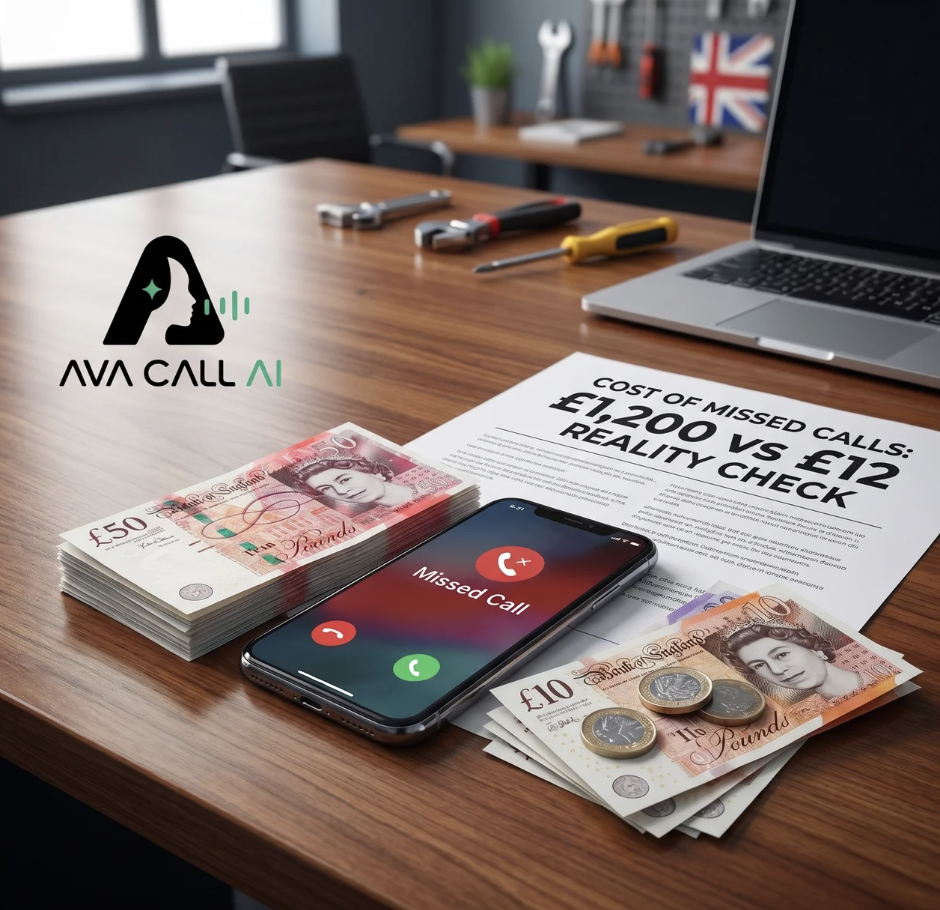
The reason you've seen wildly different figures is not because the research is wrong. It's because missed call cost is a formula with four variables — and most articles only give you one input. Consumer behaviour has also shifted hard. Today's caller is already scrolling to the next Google Maps pin before your voicemail finishes its opening message.
Notes
- A missed call costs UK service businesses between £12 and £1,200+, depending on job value, close rate, enquiry quality, and callback behaviour.
- 85% of callers who hit voicemail don't leave a message and won't try again. 78% of customers book with the first business to respond.
- The direct revenue loss is only part of the cost. Burned ad spend, lifetime value, referral chain damage, and Google Maps ranking signals compound it.
- Emergency trades, dental, and MedSpa businesses face the highest per-call loss. Low-ticket services like beauty salons face the lowest.
- The window to recover a missed enquiry is approximately 4 minutes before conversion probability collapses.
Both Figures Are Real. That's the Problem.
A widely cited BT Business study puts the cost of a missed call at £1,200. Other UK sources quote £12.15. Some say £78. None of them are wrong — they're each applying the formula to a different type of business with different assumptions.
The issue is that readers see a range this wide and conclude the number is meaningless. It isn't. Once you know the four inputs, the £1,188 gap between those two figures makes complete sense. The goal of this article is to give you the exact calculation for your business, not a generic benchmark that doesn't apply to you.
What Actually Determines the Cost of a Missed Call
The formula is: Genuine Enquiry Rate × Conversion Rate × Average Job Value. That single equation explains everything. A dental clinic and a beauty salon can receive the same missed call on the same morning and face costs that are £1,400 apart. The inputs vary — the method doesn't.
Input 1: Average job value. A £65 lash booking and a £1,400 composite bonding consultation are entirely different revenue events. So are a £350 emergency plumbing callout and a £3,500 boiler system overhaul.
Input 2: Close rate on live calls vs. callbacks. If you close 60% of calls answered live, that's your ceiling. But that same enquiry called back 30 minutes later closes at around 15-20%. The moment you miss the call, your close rate has already dropped by two thirds — before you've even dialled back.
Input 3: Genuine enquiry rate. Not every missed call is a lost customer. Industry data puts the non-enquiry portion of inbound calls at 20-40% — existing clients checking in, supplier calls, spam, wrong numbers. Strip those out before you run any calculation. The number is still bad. Just accurate.
Input 4: Callback behaviour. This is the variable that quietly destroys small business revenue and rarely gets discussed. 85% of callers who reach an unanswered line don't leave a message and won't try the number again. They go straight back to Google Maps and book with whoever answers. The first business to respond wins 78% of bookings. These two facts running simultaneously mean that missed call recovery is almost never a "call them back tomorrow" problem. It's a seconds-level problem.
Three UK Businesses, Same Missed Call, Three Different Losses
This is the comparison nobody publishes. Three real service business profiles. Same missed call event. Same formula. Different inputs.
Emergency Plumber (South East, owner-operator)
- Average callout + repair job: £350
- But the scenario: a landlord with three rental properties calling about an emergency. Real job value: £3,500+
- Close rate on live answered calls: 65%
- Close rate on 30-minute callback: 15%
- Genuine enquiry rate: 70%
Direct cost per missed call: £158. If it's a portfolio landlord: £1,575+. The plumber who was finishing a £60 tap washer job didn't lose £60 worth of time when that call rang out. They lost £1,575 to save the hour.
Private Dental Clinic (London)
- First appointment value: £800 (exam + initial treatment)
- Lifetime patient value over 4 years: £3,200
- Close rate on live call: 55%
- Genuine enquiry rate: 80% — people calling a dental clinic want a dental appointment
- LTV-adjusted close rate applied: 55%
Direct cost per missed call: £440. LTV-adjusted cost: £1,760. The £1,200 benchmark is a reasonable midpoint for a dental practice. It isn't inflated. It's conservative if you factor in referrals.
Beauty Salon (mid-market, regional)
- Average booking: £65
- Close rate on live call: 50%
- Genuine enquiry rate: 60%
Cost per missed call: £19.50.
The £1,200 figure is real for the dental clinic. The £12 figure is close to real for the beauty salon. Apply the wrong one to your business and you'll either panic unnecessarily or ignore a genuine six-figure annual problem.
The Hidden Costs Nobody Calculates
The formula above captures direct revenue. It misses three compounding factors that matter significantly for any business running paid acquisition or operating on repeat clients.
Burned ad spend. If you're running Google Ads or Meta campaigns to generate inbound enquiries, every missed call is a double loss. You already paid £15-40 in cost-per-click to get that caller to your number. Missing the call doesn't refund the ad spend. You paid to fill your pipeline and then left it running to voicemail.
Referral chain damage. The patient you didn't book doesn't just disappear into a neutral state. They book with a competitor, have a good experience, and refer two people in the next 12 months. That one missed call cost you the booking, the LTV, and the referral network downstream. These numbers compound invisibly and never show up in a call log.
Local search signal decay. This rarely appears in coverage of missed call costs and it should. Google's local algorithm factors in engagement quality. A business that demonstrates poor phone interaction patterns over time — missed calls, low engagement, no review signal generated from those callers — tends to underperform in Google Maps pack rankings. Missing calls isn't only a revenue problem. It's an SEO problem that feeds back into fewer calls in the future.
Why Callers Don't Wait (And Won't)
85% of callers who reach a voicemail don't leave a message and won't call again. 78% of bookings go to the first business that responds. The recovery window for a missed inbound enquiry — before conversion probability collapses — is approximately 4 minutes. After 30 minutes, the realistic close rate on a callback is 15-20%. After 24 hours, it's single digits.
The assumption that "serious buyers will call back" is measurably wrong for the majority of inbound enquiries to UK service businesses. Callers to a plumber, dental clinic, or MedSpa are typically in execution mode. A toothache that finally crossed the threshold. A burst pipe at 7pm. A procedure they've been researching for three weeks and just decided to book. These are high-intent, time-pressured moments.
When the call goes unanswered, that intent doesn't pause. It redirects. The caller is back on Google Maps inside 60 seconds. They're looking at the next three listings. The business that picks up gets the booking. The business that rang out gets nothing — not even a voicemail.
UK solo trades and owner-operated service businesses are particularly exposed here because the most common missed call scenario isn't neglect. It's the owner being exactly where they should be: finishing a job, in a consultation, in a meeting. The £60 job they're completing costs them the £3,500 job they're missing. That arithmetic almost never resolves in their favour.
How to Calculate Your Own Missed Call Cost (5-Minute Audit)
Pull up your phone's actual missed call log for the last 7 days. Not an estimate. The real log.
Step 1: Count total missed calls. Most owners guess 3-5 per week. The actual figure is usually 8-15 for an active owner-operated service business.
Step 2: Remove non-enquiries. Known suppliers, your own carriers, current clients you recognise. Strip 20-40% depending on your type of business.
Step 3: Apply your genuine close rate. If you close 55% of live inbound calls, that's your maximum possible recovery rate for those missed calls.
Step 4: Multiply by your average new-client job value. Use the first-transaction value, not LTV, to keep this conservative.
Step 5: Multiply the result by 0.15. Because 85% of those callers won't ring back, your realistic recovery rate on missed calls through outbound follow-up is approximately 15%. This is your weekly missed call cost.
Multiply by 52 for your annual figure.
UK sector job value benchmarks (2026):
| Sector | Average New Client Job Value |
|---|---|
| Emergency plumber / electrician | £350–£600 |
| HVAC (service + installation) | £450–£2,500 |
| Private dental clinic | £600–£1,400 |
| MedSpa (aesthetics, first treatment) | £350–£900 |
| Solicitor (initial matter value) | £1,200–£3,000 |
| Veterinary (new patient, first visit) | £80–£220 |
| Beauty salon | £45–£85 |
| Driving school (course value) | £300–£600 |
Frequently Asked Questions
Is £1,200 per missed call a realistic figure for UK businesses?
For high-ticket service businesses that account for lifetime value, yes. A dental patient worth £3,200 over four years, with a 55% close rate on live calls, represents approximately £1,760 in LTV per missed call. For low-ticket services like beauty or local retail, the direct cost per missed call is far lower — typically £12-30. The figure is accurate for the right type of business. Applying it universally inflates the number; ignoring it entirely understates the real cost for trades and professional services.
What percentage of callers don't leave a voicemail?
UK and US telecom research consistently puts the figure at 80-85%. The majority of callers who reach an unanswered line hang up without leaving a message, and most won't attempt the number again. Consumer behaviour data from callback studies confirms that the "they'll leave a voicemail if they're serious" assumption is factually wrong for the majority of inbound service enquiries.
Does calling back quickly actually improve conversion rates?
Yes, and the drop-off is steep. Callbacks within 5 minutes convert at near-live-answer rates. After 30 minutes, conversion drops to around 15-20%. After 24 hours, the probability of converting that specific caller is in single digits for most service businesses. For emergency trade enquiries (plumbers, electricians, locksmiths), the window is even shorter — most callers in crisis mode have booked with a competitor within 10-15 minutes of their first call.
How does missing calls affect my Google Maps ranking?
Google's local algorithm incorporates engagement quality signals. While the exact weighting isn't publicly documented, businesses with consistently poor phone interaction metrics tend to underperform in local pack rankings over time. Missed calls also generate no positive review signal — customers who didn't get through don't leave reviews, which compounds the ranking effect. Fixing call handling isn't only a revenue action. For local search visibility, it's an SEO action.
What's the difference between total missed calls and revenue-bearing missed enquiries?
Revenue-bearing missed enquiries are calls from genuine new-business prospects with intent to book. Total missed calls include everything — existing clients, suppliers, spam, wrong numbers, pocket dials. For most UK service businesses, 60-80% of missed calls are genuine enquiries. Running the cost calculation against total missed calls overstates the loss. Stripping out non-enquiries first gives you a more accurate and still typically significant number.
Should I hire a receptionist to solve this?
A part-time receptionist costs £24,000–£28,000 per year minimum and covers business hours only. That fixes a fraction of the problem because a significant share of high-intent service enquiries come in outside standard hours — evenings, weekends, and during the hours when the owner is physically unavailable. An AI receptionist handles every call simultaneously at a flat monthly cost, books directly into your calendar, and operates 24/7 with no per-call charges and no missed shift.
How do I calculate the cost of a missed call for my specific business?
Use the formula: Missed calls per week × Genuine enquiry rate × Close rate × Average job value × 0.15 (realistic callback recovery). That final number is your weekly direct revenue leak. If you want a detailed breakdown for your vertical without running the numbers yourself, Ava's free AI Audit calculates this for your specific sector in about 10 minutes.
The Practical Takeaway
Run the 5-minute audit above on your actual call log from last week — not an estimate, the real list. Most UK service business owners who do this find a weekly missed-call cost between £300 and £2,000. Not because the business is failing. Because owner-operators are unavailable exactly when high-intent callers are dialling.
The gap between £12 and £1,200 is not a mystery. It's your job value multiplied by your close rate multiplied by a callback probability that is almost always lower than you think. Once you know your number, the cost of doing nothing is concrete, monthly, and compounding.