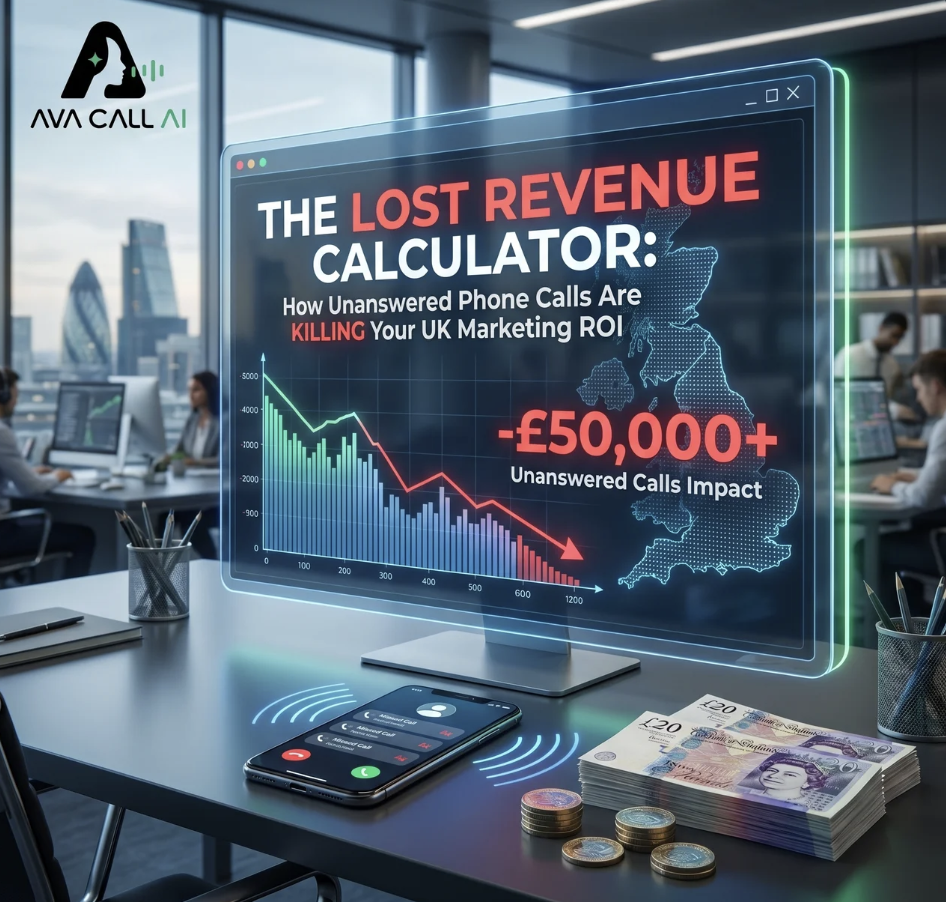
UK cost-per-click has climbed 15-25% over the past 18 months across Google Ads and Meta for local service categories. Every click costs more. Every call costs more to generate. And a significant percentage of those calls — across every industry we have data for — are going unanswered. That's not a marketing problem. That's a maths problem, and it's compounding every month you don't fix it.
Notes
- Every missed call from a paid or organic marketing channel represents a double loss: acquisition cost paid, revenue not collected.
- Your Google Ads dashboard reports a cost per lead based on calls generated. It has no visibility into how many of those calls were answered. Your true CPL is likely 40-70% higher than what your account shows.
- The formula is: True CPL = Stated CPL ÷ (1 - Missed Call Rate). At a 40% missed call rate and £30 CPL, your real CPL is £50.
- Fixing the phone doesn't improve your ad performance. It reveals the ad performance you already have but are failing to convert.
- A business spending £1,500/month on Google Ads with a 40% missed call rate is effectively spending £2,100/month for the bookings they actually get.
The Metric Your Agency Isn't Reporting
Your ad platform reports calls generated. It doesn't report calls answered. That gap is where your marketing budget goes to die. For most UK service businesses running local paid search or Meta campaigns, the reported CPL is a fiction — an optimistic number that assumes every generated call was a conversion opportunity you saw.
Google Ads call tracking fires a conversion when the phone rings for more than a set duration — typically 60 seconds. It has no data on whether anyone picked up. Your agency sends a report showing 40 calls, £25 CPL, and strong volume. What it doesn't show is that 16 of those calls rang out, 14 of those callers didn't try again, and you effectively paid £25 each to hang up on them.
This is what the research refers to as the "Marketing Deficit Assumption" — the belief that a drop in booked jobs means the advertising isn't working, when in reality the ads are converting perfectly. The funnel is working up until the point it hits your phone.
Your Conversion Funnel Has a Hole in It
Most marketing funnels are built as: Ad → Click → Call → Booked. The assumption is that the call closes the funnel. It doesn't. The complete funnel is: Ad → Click → Call → Answered → Booked. That second-to-last step is where UK service businesses lose between 20% and 45% of the revenue their marketing already paid to generate.
Here's what the funnel actually looks like for a typical owner-operated service business running Google Ads:
- Ad served to a high-intent local searcher
- Click at £8-25 per click depending on category
- Call placed to the business number
- Owner is on-site, in a consultation, or finishing a job
- Phone rings out or hits voicemail
- Caller scrolls back to Google Maps
- Competitor picks up. Books the job.
- Google Ads records a call conversion. CPL looks fine.
Step 4 is the problem. Steps 5-7 are the consequence. Step 8 is why nobody catches it.
The industry-wide data backs this up. 85% of callers who reach voicemail don't leave a message and don't call back. 78% of customers book with the first business to respond. For emergency service categories — plumbing, electrical, locksmith, HVAC — callers in active distress are booking with whoever answers within the first 10-15 minutes. If that isn't you, it's the next result on the map.
How to Calculate Your True Cost Per Lead
True CPL = Stated CPL ÷ (1 - Missed Call Rate). This is the only CPL figure that matters for evaluating whether your marketing is actually profitable. The stated CPL from your ad platform overstates performance because it counts every generated call, not every answered one.
Run this calculation on your own numbers:
Step 1: Pull your actual missed call rate. Check your phone's missed call log for the last 14 days. Count the missed calls. Divide by total incoming calls. Most UK service businesses operating without a dedicated receptionist miss 25-45% of inbound calls.
Step 2: Adjust your CPL.
| Stated CPL | Missed Call Rate | True CPL |
|---|---|---|
| £20 | 25% | £26.67 |
| £20 | 40% | £33.33 |
| £30 | 25% | £40.00 |
| £30 | 40% | £50.00 |
| £50 | 25% | £66.67 |
| £50 | 40% | £83.33 |
Step 3: Recalculate your ROAS with the corrected CPL. If your current marketing ROI calculation assumes every generated call had a chance to convert, your real ROI is proportionally lower.
Step 4: Calculate what fixing the phone is worth. This isn't theoretical. If you spend £1,500/month on Google Ads, generate 60 calls, and answer 36 of them, you are getting 60% of the possible return on that £1,500. Fixing the answer rate to 95% doesn't cost another £1,500. It costs a fraction of that — and it returns revenue from budget you already spent.
The Three Ad Channels Where This Hurts Most
This calculation plays out differently depending on where your traffic comes from. Here are the three most common scenarios for UK service businesses.
Google Ads (Local Services and Search)
This is the most painful channel for missed calls because the intent is highest. Someone searching "emergency plumber Croydon" or "teeth whitening near me" and clicking a paid result is in active buying mode. They've already expressed intent. You paid £10-40 for that click.
When they ring and get no answer, you've spent up to £40 to lose a sale to your next competitor on the page. There is no softer way to say that.
Realistic numbers for a dental clinic on local search:
- Monthly Google Ads spend: £2,000
- Calls generated: 80
- Missed calls (35% rate): 28
- Calls that result in an answered conversation: 52
- Close rate: 55%
- New patients booked: 28.6
- Average first appointment value: £800
- Monthly ad-attributed revenue: £22,880
- True CPL (adjusted): £38.46 vs. reported £25
If those 28 missed calls had been answered at the same 55% close rate:
- Additional bookings: 15.4
- Additional revenue: £12,320
- Total monthly revenue from the same £2,000 spend: £35,200
The marketing budget didn't change. The targeting didn't change. The ad creative didn't change. Answering the phone changed the revenue by 54%.
Meta Ads (Facebook and Instagram, Local Lead Gen)
Meta delivers lower intent than search — callers generated from Facebook campaigns are typically in a "considering" rather than "ready to buy" state. But the economics of missed calls are, if anything, worse here because the close window is shorter.
A Meta-generated lead who calls and doesn't get through is easier to lose than a search lead. They were browsing. They made an impulse decision to enquire. They'll forget about it by the time you call back.
UK Meta CPL for local services typically runs £15-35 per call or form submission in competitive verticals. Miss 40% of those and your effective acquisition cost for a closed booking is significantly higher — and the likelihood of recovering those missed leads through outbound is under 15%.
Google Business Profile (Organic / Local SEO)
This one catches business owners off guard because it feels "free." It isn't. Your Google Business Profile ranking represents months of review generation, post cadence, photo uploads, and category optimisation — or a monthly SEO retainer at £500-2,000. That investment generated calls. Calls you missed.
Even if you didn't run paid ads, every missed call from your GMB listing is an ROI failure on your organic marketing investment. The acquisition cost is just spread across the SEO budget rather than sitting in a single ad account line item.
What 12 Months of Missed Calls Does to a Marketing Budget
Most businesses look at missed call cost as a per-call problem. Run it as an annual compounding problem and the number becomes very difficult to ignore.
Example: A South East plumbing business, realistic inputs
- Monthly ad spend (Google Ads + GMB management): £1,800
- Inbound calls per month from marketing: 90
- Current missed call rate: 38%
- Calls missed per month: 34
- Genuine enquiries among missed calls: 70%
- Missed genuine enquiries per month: 24
- Close rate had they been answered: 60%
- Lost bookings per month: 14.4
- Average job value: £420
- Monthly revenue leaked through missed calls: £6,048
- Annual revenue leaked: £72,576
That business is spending £21,600 per year on marketing and losing £72,576 in potential revenue from the same marketing, because 38% of calls aren't being answered. The ad account looks healthy. The bookings are below where they should be. The owner thinks they need a bigger marketing budget. They don't. They need to answer the phone.
The "Busy and Missing It" Trap
The research on this topic surfaces one scenario more than any other. A solo trade or owner-operated service business is in the middle of a billable job. Their phone rings. They can't pick up. The caller is a new enquiry with a high-value job. That caller hangs up and books the next business that answers.
The owner finishes their current job at, say, £75 profit. They call back an hour later. The lead is gone. They just sold a £75 hour to lose a £600 job.
This isn't a discipline failure. It's a structural problem. The solo operator cannot simultaneously deliver work and handle the phone. Every hour they're generating revenue, they're also unavailable to capture the next piece of revenue. That's the ceiling — until you break the assumption that a human has to answer.
An AI receptionist removes that ceiling entirely. Ava answers every call, qualifies the enquiry, and books directly into the calendar while the owner is still on-site. The £600 job doesn't get missed. The £75 job gets finished. Both outcomes happen in parallel.
Frequently Asked Questions
How do I calculate my true cost per lead accounting for missed calls?
Use the formula: True CPL = Stated CPL ÷ (1 - Missed Call Rate). Find your missed call rate by checking your actual phone log for the last 14 days and dividing missed calls by total incoming calls. At a 40% missed call rate, a stated CPL of £30 becomes a true CPL of £50. Apply that figure to your ROAS calculation for an accurate picture of what your marketing is actually returning.
Why doesn't my Google Ads account show me how many calls were answered?
Google Ads call tracking records a conversion when a call is connected for longer than a threshold duration you set (usually 60 seconds). It doesn't integrate with your actual phone system to detect whether the call was answered by a human, went to voicemail, or rang out. Your ad platform reports call volume and duration — not answer rate. The answer rate is your responsibility to measure separately, via your phone provider or a dedicated call tracking platform like CallRail.
What is a typical missed call rate for a UK service business?
Industry data across UK SMBs puts the missed call rate between 22% and 45% for owner-operated businesses without a dedicated receptionist. The figure is higher during peak working hours (when staff are with clients), during evenings and weekends, and for sole traders who work on-site. Businesses with a part-time receptionist typically see rates of 8-15% outside receptionist hours.
Does a high call volume from my ads prove the marketing is working?
Not on its own. High call volume proves your targeting and creative are generating interest. Whether that interest converts to revenue depends entirely on what happens when the call is answered — or isn't. A campaign generating 100 calls per month with a 40% missed call rate and a 55% close rate produces 33 bookings. The same campaign with a 5% missed call rate and the same close rate produces 52 bookings. The ads didn't change. The answer rate changed.
Can I recover missed calls by calling back quickly?
Partially. Callbacks within 5 minutes of a missed call convert at close to live-answer rates. After 30 minutes, conversion rate drops to around 15-20%. After the same business day, conversion is in single digits for most categories. For emergency or high-urgency services, the window is shorter still. The limiting factor for solo operators is that they're usually unavailable for callbacks at the same time they missed the call. A structured SMS text-back within 30 seconds of a missed call can hold the caller's attention before a human callback — but it doesn't replace answering live.
Is this only a problem for businesses running paid ads?
No. Any inbound marketing that generates phone calls — organic SEO, Google Business Profile, directory listings, referral networks, word of mouth — has an implicit acquisition cost. A call from your GMB listing represents investment in review generation, profile optimisation, and SEO. A referral call represents relationship-building and reputation capital. Missing those calls is an ROI failure on that investment, even if the cost doesn't sit in an ad account.
What's the fastest way to stop the marketing budget leak?
The single highest-leverage action is ensuring every inbound call receives a live response. For businesses that can't maintain consistent phone coverage, an AI receptionist handles inbound 24/7, qualifies the caller, and books directly into the calendar — converting the call within seconds rather than letting it ring out. If you want to audit how much your business is currently leaking before committing to a fix, Ava's free AI Audit runs the calculation for your specific vertical and call volume.
The Practical Takeaway
Pull your ad spend figure for last month. Divide it by your real answer rate (not the one you estimate — the one your call log shows). That's your actual cost per answered enquiry. Then apply your close rate to find your true cost per booking.
For most UK service businesses running paid local ads, that number is 40-70% higher than the figure in the dashboard. The budget isn't the problem. The conversion environment is. And unlike increasing ad spend, fixing the answer rate doesn't cost proportionally more per booking generated — it returns revenue from spend you've already committed.
The goal isn't to spend less on marketing. It's to stop paying twice for every lead you generate and then lose on the handset.